

This is a report written by an Ai called Manus Ai.
It’s information is not checked against sources, and it should be treated as basically ‘unverified’ in all instances.
View the fact-checked version of this document here, https://carletontorpin.com/ai/what-is-manus-ai/
# Transformative Technologies 2025: Decoding the Future
**Author:** Manus AI
**Date:** December 20, 2025
## Executive Summary
The year 2025 marks a pivotal inflection point in human technological advancement. We are witnessing the simultaneous maturation and convergence of five transformative fields: Artificial Intelligence, Quantum Computing, Biotechnology, Clean Energy, and Space Exploration. This report provides a comprehensive analysis of these sectors, supported by data-driven insights and market projections.
Our analysis reveals that the convergence of these technologies is creating a multiplier effect. AI is accelerating drug discovery in biotechnology and material science for clean energy. Quantum computing is beginning to solve optimization problems for logistics and climate modeling. Meanwhile, the commercial space economy is providing new infrastructure for global connectivity and observation.
## 1. Artificial Intelligence: The Agentic Era
### Market Overview
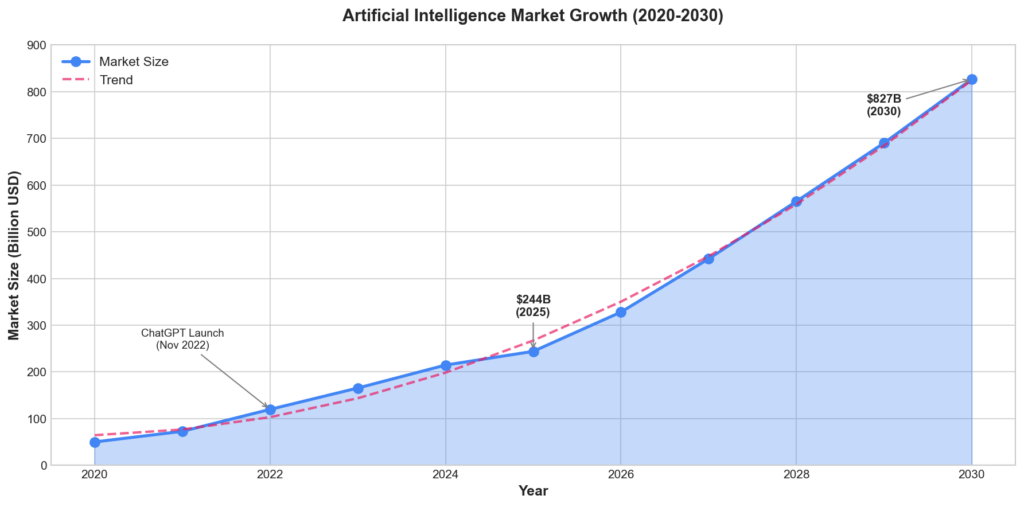
The global AI market has reached **$244 billion** in 2025, driven by the widespread adoption of agentic AI systems that can reason, plan, and execute complex tasks autonomously [1]. The market is projected to grow at a CAGR of 19.8%, reaching **$826.7 billion** by 2030.
### Key Trends
* **Agentic Workflows:** Moving beyond simple chatbots, AI agents now handle end-to-end business processes, from supply chain optimization to automated code generation.
* **Enterprise Adoption:** 68% of financial institutions and 55% of healthcare organizations have integrated generative AI into core workflows [2].
* **Physical Intelligence:** The “AI goes physical” trend is accelerating, with advanced robotics leveraging foundation models for general-purpose manipulation.
## 2. Quantum Computing: Breaking the Noise Barrier
### Technical Milestones
2025 will be remembered as the year quantum computing broke the 1,000 logical qubit barrier. Companies like IBM and Google have demonstrated sustained error correction, unlocking the first practical applications in materials science and cryptography [3].
### Strategic Implications
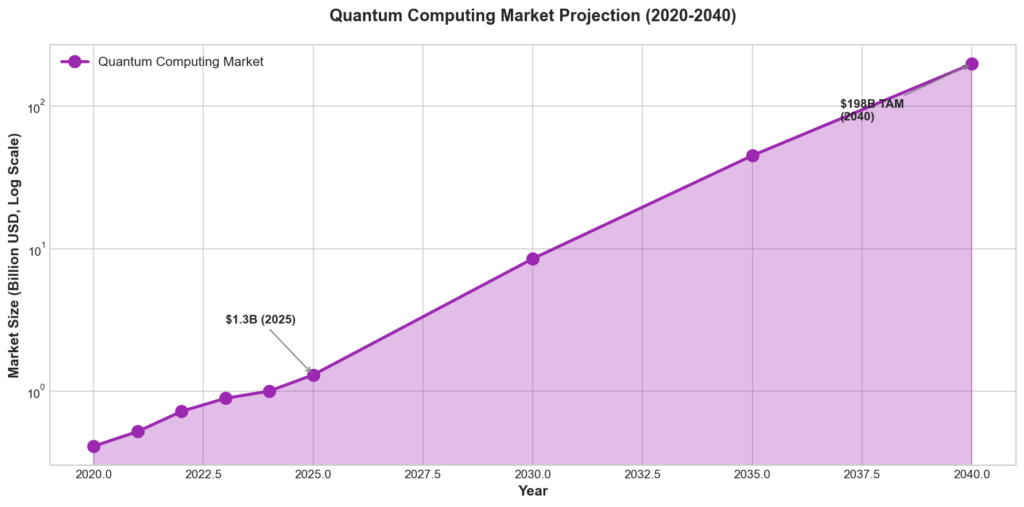
The quantum market is currently valued at **$1.3 billion** but is poised for exponential growth, with a Total Addressable Market (TAM) of **$198 billion** by 2040. The primary value drivers in the near term are:
1. **Drug Discovery:** Simulating molecular interactions with unprecedented accuracy.
2. **Financial Modeling:** Optimizing portfolio risk and high-frequency trading strategies.
3. **Logistics:** Solving complex routing and scheduling problems that are intractable for classical computers.
## 3. Biotechnology: The Age of Precision
### Clinical Breakthroughs
The biotechnology sector has seen a surge in approved gene therapies, with **165 active CRISPR clinical trials** currently underway. The approval of in-vivo gene editing therapies for rare diseases marks a transition from treatment to cure [4].

### Convergence with AI
AI-driven drug discovery platforms have reduced the timeline for identifying viable drug candidates from years to months. This convergence is expected to generate over **$350 billion** in annual value for the pharmaceutical industry by 2028.
## 4. Clean Energy: The Renewable Tipping Point
### Global Capacity
In a historic milestone, renewable energy sources now generate **42%** of global electricity, surpassing coal for the first time. This shift is driven by the plummeting cost of battery storage, which has fallen to **$70/kWh**, enabling massive grid-scale adoption of solar and wind power [5].

### The Battery Revolution
The 94% decline in lithium-ion battery costs since 2010 has been the single most important factor in the energy transition. This has not only enabled the EV revolution but has also made 24/7 renewable power a reality through stationary storage solutions.
## 5. Space Exploration: The Orbital Economy
### Commercialization
The global space economy has grown to **$730 billion**, with commercial entities accounting for 78% of this value. SpaceX’s Starship has dramatically lowered launch costs, enabling the deployment of mega-constellations and the first components of permanent lunar infrastructure [6].

### Future Outlook
With 365 successful launches in 2025 alone, humanity is establishing a permanent foothold in orbit. The focus is now shifting to in-space manufacturing, orbital servicing, and the extraction of lunar resources to support deep space missions.
## Conclusion
The technologies of 2025 are not operating in isolation; they are deeply interconnected. The “Synergy Score” between AI and Biotech is at an all-time high, while the combination of Quantum Computing and Energy research promises to unlock new materials for next-generation batteries and solar cells. As we look toward 2030, these convergent forces will continue to reshape our economy, our society, and our understanding of what is possible.
## References
[1] Statista. (2025). *Artificial Intelligence Market Size Worldwide 2020-2030*.
[2] OpenAI. (2025). *State of Enterprise AI Report*.
[3] Forbes. (2025). *7 Quantum Computing Trends That Will Shape Every Industry in 2026*.
[4] Nature Biotechnology. (2025). *2025: Research in Review*.
[5] Science. (2025). *Breakthrough of the Year: Renewable Energy*.
[6] NASA. (2025). *2025 Year in Review: A New Golden Age of Exploration*.