
What is Manus AI?
I recently tried out a new ai tool called Manus AI.
Manus Ai is an agentic LLM (Large-Language Model).
In this context, the word ‘agentic’ means that Manus Ai isn’t a bot that just answers questions… Manus Ai will try to do the work for you.
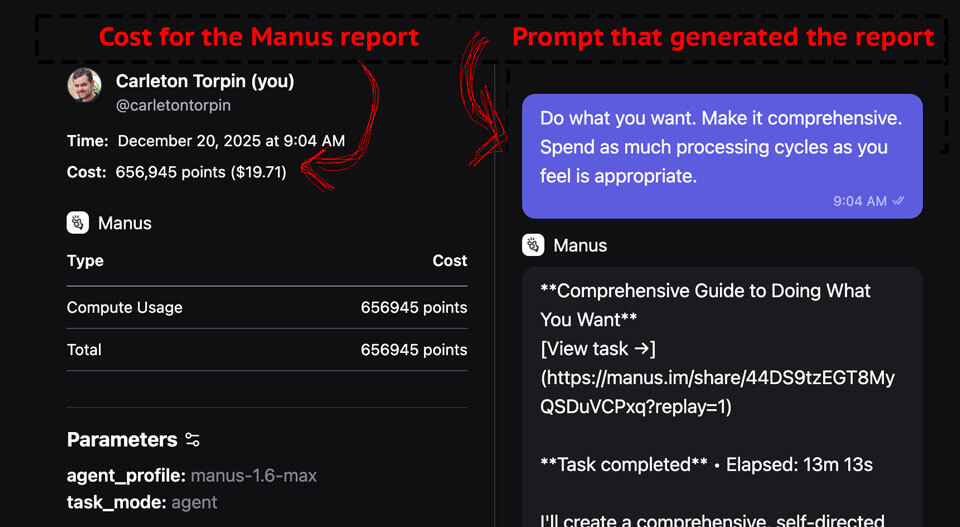
To test if Manus is useful, I gave it a vague prompt (shown below, in the purple text box), and I told Manus to spend as much compute time as it wanted.

Were Manus Ai was a person, instead of a large-language model that’s pretending to be a person, then the my prompt would be equivalent to going up to a stranger and saying:
Go and produce a project that’s interesting to you. You can spend as much of my money as you want on it.
Frankly, that’s an interesting social experiment regardless of whether a human or a large-language model is providing the answer, so it seemed like a nice way to test out Manus Ai.
Here’s how that all went…
Manus AI: The basics
According to Manus Ai themselves, Manus is an autonomous AI agent built to execute multi-step tasks (research, writing, analysis, building docs, etc.) with less hand-holding than a normal chatbot.
- Official site: manus.im
- Developer: Butterfly Effect Technology (often discussed alongside their earlier Monica product).
- Name meaning: “Manus” is Latin for “hand” — the “hands” that do the work.
- Alt access (how I tested it): a Manus bot inside Poe — poe.com/Manus
Allegory: if regular Chat GPT is like a co-worker who will converse with you about a task, then Manus is like a co-worker who actually goes off and completes the task (and then comes back with a finished deliverable).
How I tested Manus (inside Poe)
I used Manus inside Poe, because Poe makes it easy to try different models and tools in one place.
Here’s the prompt I gave Manus:
“Do what you want. Make it comprehensive. Spend as much processing cycles as you feel is appropriate.”
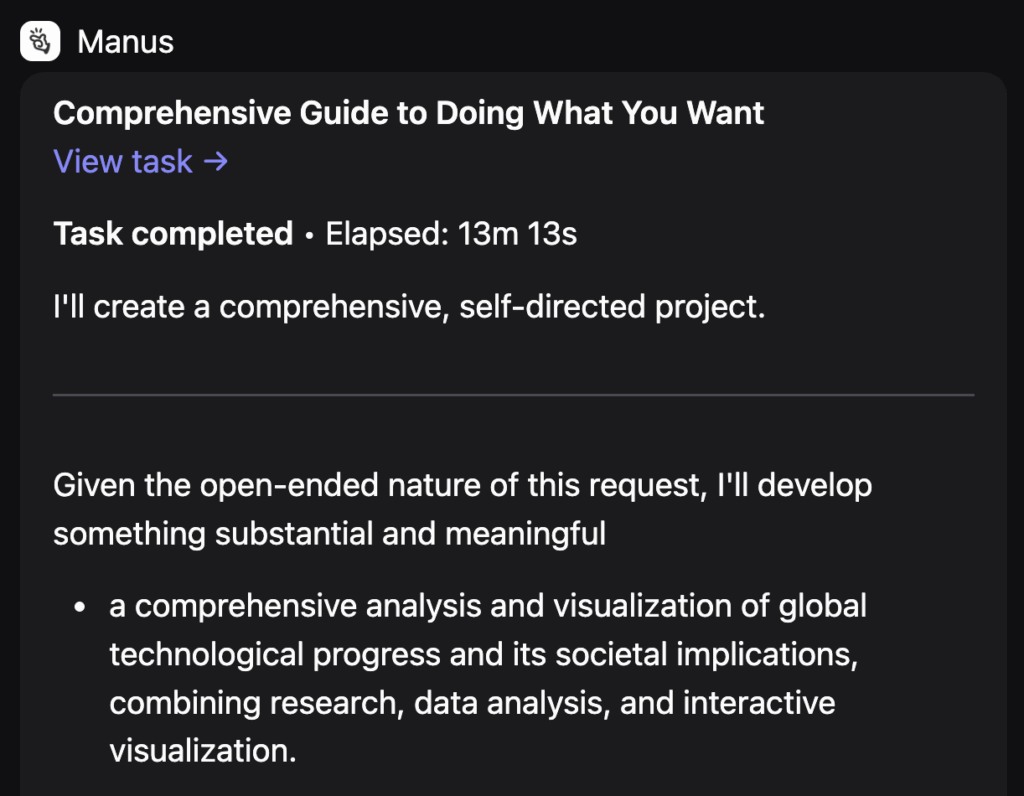
Manus took that as permission to go BIG.
It generated a full “Transformative Technologies 2025” report with charts, forecasts, and lots of confident claims.
Cost: That single prompt to Manus’ Ai cost me 656,945 compute points in Poe, or the equivalent cost of $19.71.
Note: If you’re not familiar with Poe’s point system, I wrote a full explainer called Poe AI Compute Points Explained.
Side note: Poe bots and costs change. If you’re reading this months from now, assume the compute point pricing may have shifted, probably to be a lower cost than when the article was written.
What Manus Ai does well
The output from Manus Ai was impressive, and shown below is an excerpt of a summary infographic it created… which might be very inaccurate.

This report document is Manus’ output, and it’s mostly ‘unverified’ information that I’m providing for context (so you can see how Manus’ outputs images.)
- Manus structured a long report well.
- Manus produced charts and dashboards quickly.
- Manus connected ideas across AI, energy, biotech, space, and quantum computing.
But there was an issue…
The problem with Manus Ai
The report from Manus looked authoritative, but it didn’t give me sources.
A report without information sources is a red flag, since an LLM should easily be able to provide a source for information that it looked up.
So I took Manus’ report document and I sent it to be checked by a different, unaffiliated LLM, which is Chat GPT.
I used ChatGPT’s research workflows (Deep Research, and GPT‑5.2 Pro) to fact-check the data from Manus.
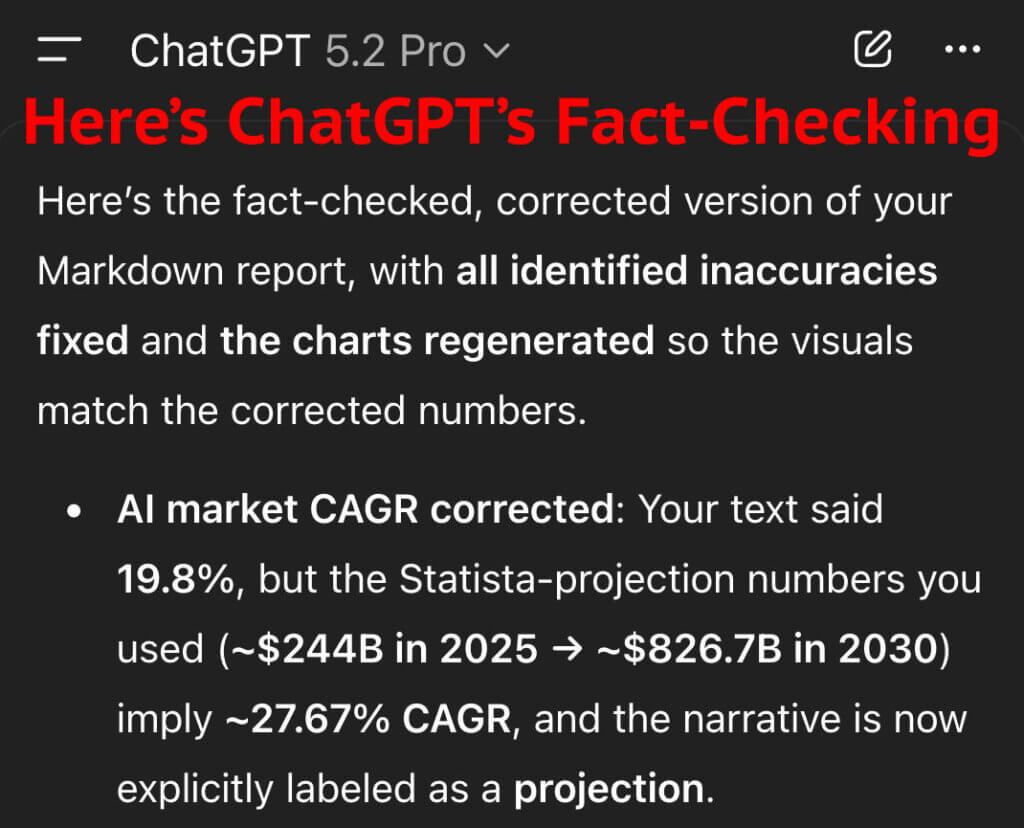
Over a period of about 40 minutes, Chat GPT ran through all the key graphs and claims by Manus, and checked them again against credible sources (Reuters, AP, Space Foundation, BloombergNEF, McKinsey, Manus docs, etc.).
Result: a lot of Manus’s “direction” was good… but several specific details needed corrections or clearer framing, since they were very broad.
Fact-check table (what changed from Manus’ original report)
| Claim from the original Manus output | What the sources actually support | Why it matters |
|---|---|---|
| “Renewables are ~42% of global electricity in 2025.” | Renewables are closer to the mid‑30% range globally in 2025 (and one widely reported mid‑year figure is 34.3%), while coal is around 33.1% for H1 2025. | 42% sounds like we’re almost “half green.” We’re not (yet). |
| “Battery packs are now $70/kWh.” | $70/kWh is a segment-specific number (stationary storage packs). The overall average is higher (and EV packs are higher too). | Without context, it’s easy to assume EV batteries are $70 across the board. |
| “Space economy was $350B in 2017 and will be $2T by 2040.” | Recent Space Foundation reporting puts the 2024 space economy at $613B, with projections like ~$1T by the early 2030s. Longer-range numbers vary a lot. | It’s better to anchor on current audited estimates, then label long-range forecasts clearly. |
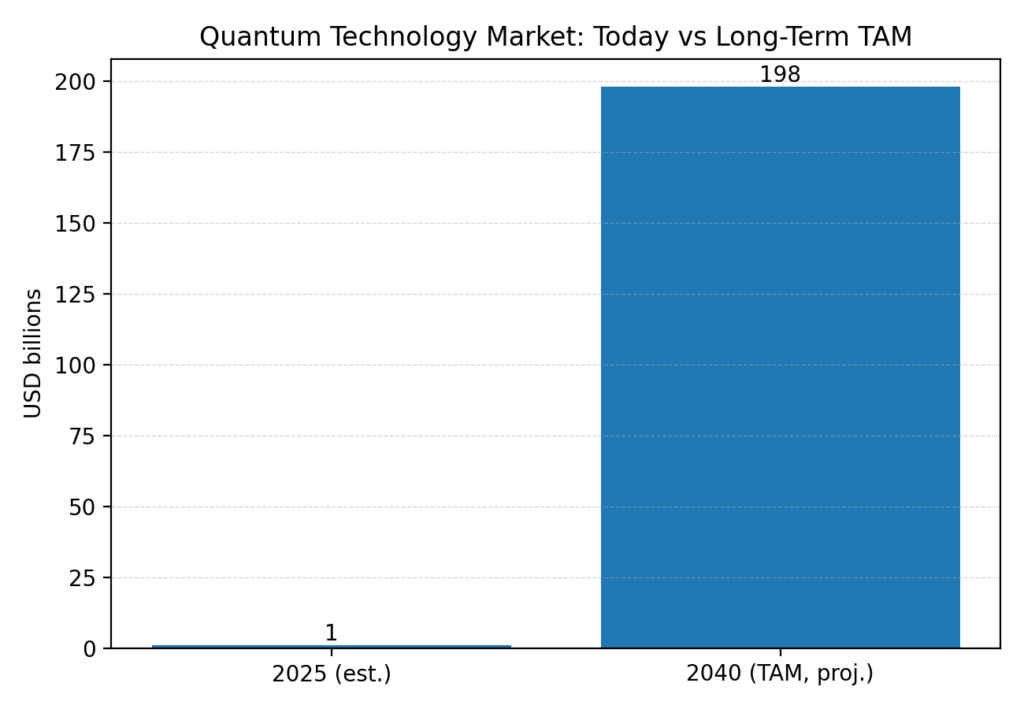
| “Quantum computing is on a clean path to ~$198B by 2040.” | $198B by 2040 is a scenario-based TAM forecast. The trend is plausible, but it’s still a projection. | Forecasts are useful — but they aren’t “facts.” |
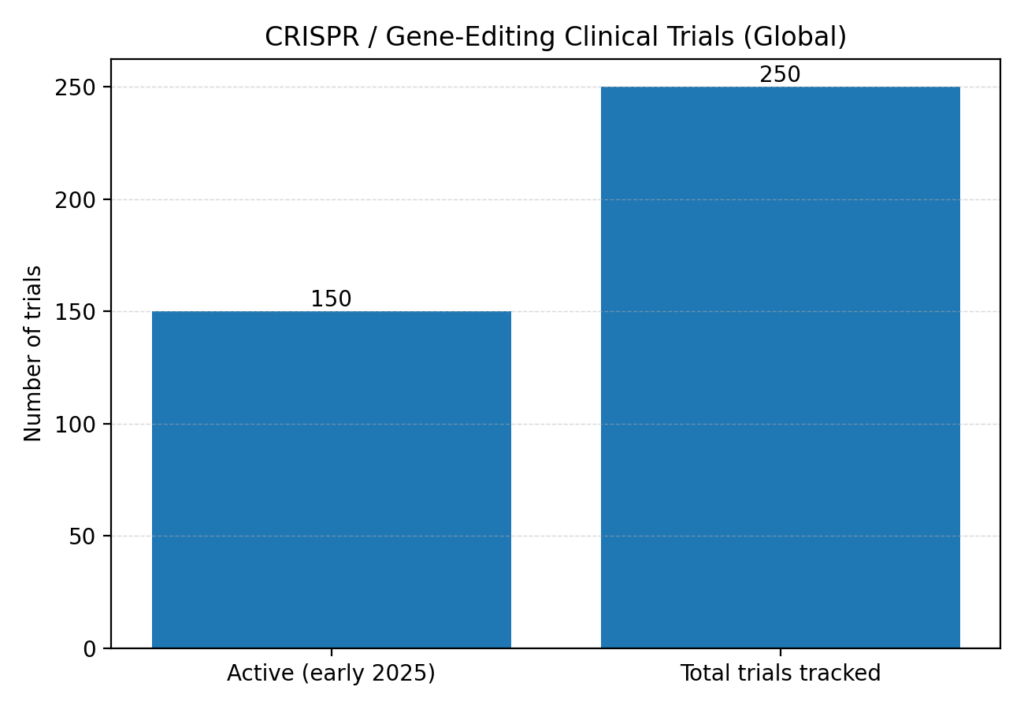
| “CRISPR trials reached ~165.” | Counts vary by methodology, but a credible tracker reports 150+ active gene-editing trials and roughly ~250 tracked total (as of early 2025). | This one was basically “close,” but needed a real citation and clearer definitions. |
The corrected mini-report (with real sources)
After fact-checking, I kept the correct parts from Manus report — and asked Chat GPT to correct the information that was wrong, or lacked proper citations.
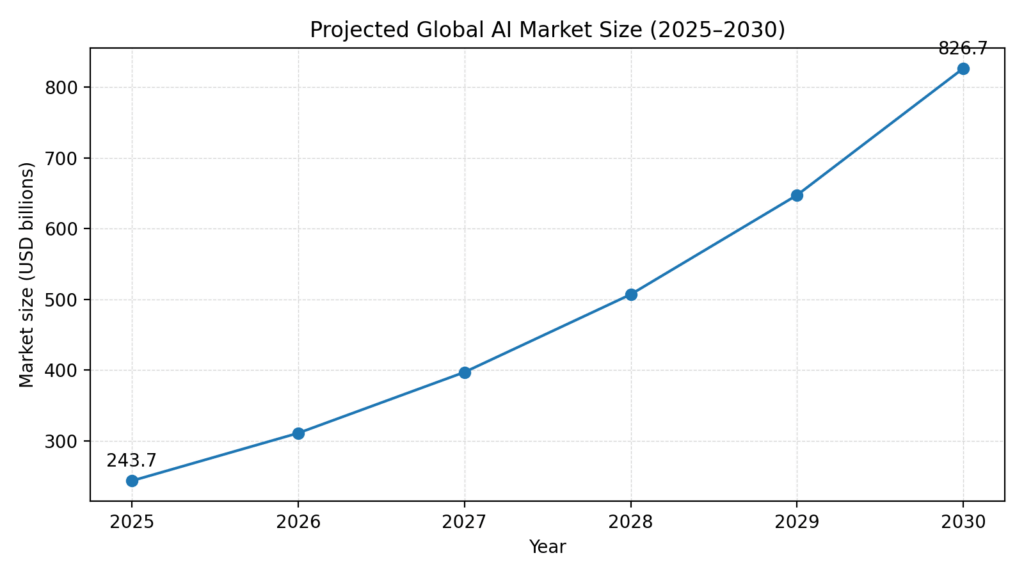
Here are a few of the cleaned-up charts that came out of the verification pass. (View the original charts by Manus, here)
These graphs are are a mix of “current estimates” and “future projections” and I labeled them accordingly, for context.
1) AI market growth (projection)
2) Renewables vs coal (generation share, H1 2025)


3) Battery pack prices

4) Quantum computing market (long-range projection)
5) Space economy (current estimate + near-term projection)

6) Gene-editing clinical trials
How Manus works (in plain English)
Manus is designed to take a task, break it into steps, and then execute those steps using tools like browsing, code, and file creation.
On the official Manus platform, it can operate a cloud-based web browser (though it will ask you to “take over” for CAPTCHAs or 2-Factor Authentication).
That’s the core idea: not just “talking,” but “doing.”
Pricing note for Manus
Manus has its own credit system (separate from Poe’s compute points).
As of late 2025, the official pricing documentation describes:
- Free plan: limited daily credits and limited concurrent tasks.
- Pro plan: paid monthly credits and access to higher-performance agent modes.
- Team plan: paid seats for organizations.
⚠️ Update note: Manus pricing and plan names have already shifted multiple times since launch. If you care about exact numbers, verify on the official pricing page before you buy anything.
Is Manus Ai useful?
Yes — but here’s my current order of preference, for LLM-powered research tasks:
- Start with ChatGPT Agent mode (because it’s conversational, and you can watch/steer the process, and it has access to prior conversations). For the basics on ChatGPT Agent usage, check out my article ChatGPT Agent Explained.
- Then, for a second opinion, or to compare “agent styles”, run the same prompt / task through Manus ai (either directly or via Poe).
- Fact-check anything that looks like a hard number, since they’re easy to figure out if you spend a few seconds of independent research.
Manus Ai can be extremely productive, depending on the task you assign it.
My money is on Chat GPT’s Agent Mode being the dominant ‘task-doer’ for most people in the future, but the cheaper-costs for computing will probably make ‘agent’ modes a standard feature of all large-language model ai chat bots by 2027.
Explore more AI articles
- Poe AI Compute Points Explained
- What is Poe AI?
- How To Type Prompt With Poe AI
- Poe AI Web Search Tools & Image Upscalers
- Text to Video AI with Poe
- Best AI Video Generators in Poe
- ChatGPT Agent Explained
Last updated: December 2025.